
How to Recognize Nervous System Dysregulation (And Get Out of Survival Mode)

Have you ever felt like your body’s internal volume knob is permanently turned up too high?
Maybe you find yourself chronically anxious, hyper-vigilant, and "wired" even when you are entirely safe. Or perhaps you experience the exact opposite: feeling completely shut down, unmotivated, heavy, and operating on an icy autopilot.
If your emotional and physical responses feel painfully disconnected from your actual surroundings, please know this: You are not failing, and you are not broken. You might just be experiencing nervous system dysregulation.
When we understand why our bodies choose these states, the path back to our center becomes much clearer. Let’s explore what is happening beneath the surface and how to gently guide your system back to safety.
What is Nervous System Dysregulation?
To understand how we get stuck, it helps to look very briefly at how our bodies are wired. We have two main divisions in our nervous system: the somatic nervous system (which controls voluntary movements, like reaching for a cup of coffee) and the Autonomic Nervous System (ANS).
The Autonomic Nervous System is your body’s completely automatic, behind-the-scenes control panel. It regulates the vital functions you don't have to consciously think about, including your heart rate, digestion, immune system, and breathing rhythm. At its core, your ANS acts as your body’s personal surveillance system. Its primary job is to scan your environment for cues of safety or threat. In a perfectly balanced system, you ride the waves of life smoothly by switching between two main pathways of the ANS:
The Accelerator (Sympathetic Branch): Kicks in when you need energy, focus, or protection (the "fight or flight" response). It dilates your airways and speeds up your heart to prep you for action.
The Brakes (Parasympathetic Branch): Settles your body down into a state of rest, digestion, and deep social connection.
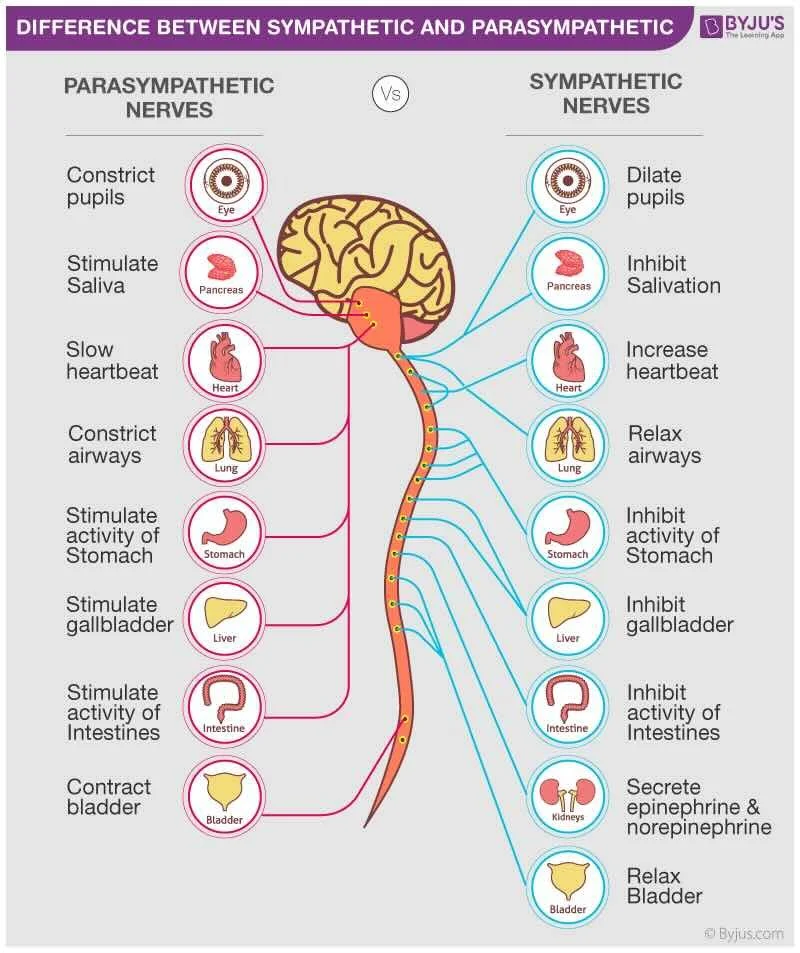
Image source: BYJU'S Biology
When the Control Panel “Loses Control”
Nervous system dysregulation happens when your body loses its ability to return to that baseline of calm after a stressor has passed. When we experience prolonged stress, chronic burnout, or past trauma, this beautiful mechanism gets "stuck." Your smoke alarm stays on, even when there is no smoke in the room.
Because the ANS directly controls your vital organs, dysregulation isn't just an emotional feeling; it manifests as intense, confusing physical symptoms. When your system is misfiring, things like heart rate and breathing can suddenly feel impossible to "control."
This is exactly why people with a dysregulated system frequently report experiencing sudden heart palpitations out of nowhere, a persistent feeling of breathlessness, or a phenomenon known as "air hunger", where you feel like you can't take a deep enough breath no matter how hard you try. Your brain is falsely signaling that you need more oxygen to run from a threat, leaving you physically trapped in a cycle of over-breathing.
What is Actually Happening to Your Nerves?
When people hear that their nervous system is dysregulated, they often wonder what that actually means. It is incredibly common to worry that your system is physically broken, that your nerves have simply stopped working, or that you have lost the ability to ever feel safe again. You might find yourself asking: Are my nerves literally getting physically stuck somewhere?
Physically, your nerves aren't frayed, broken, or structurally damaged. Instead, think of it as a software issue, not a hardware issue.
The main highway of your parasympathetic braking system is the Vagus Nerve, an expansive nerve that travels from your brainstem all the way down to your heart, lungs, and gut. In a healthy system, you have high "vagal tone", meaning your vagus nerve is flexible and highly responsive, easily slowing your heart rate down the moment a stressful event ends.
When you are under chronic stress or carrying unhealed trauma, your vagal tone drops. The nerve pathways essentially get “stuck” in a biological feedback loop of threat and danger. The sympathetic accelerator gets jammed down, and your vagus nerve loses its "fitness" to apply the brakes. Your muscles tighten, your gut slows down, and your chest restricts because your body is now structurally bracing for an impact that never comes.
To regulate doesn't mean you never feel stressed again; it simply means restoring that "fitness" to your nervous system software, expanding your body's capacity to naturally apply the brakes and safely return to calm after the storm passes.
Symptoms of a Dysregulated Nervous System
1. Stuck on "High Alert" (Hyperarousal)
When your nervous system is trapped in an overactive fight-or-flight response, you might experience:
Persistent, racing thoughts and chronic worry.
Feeling "wired but tired”, exhausted but unable to sleep soundly.
Unexplained physical symptoms like heart palpitations, chronic muscle tension, random body aches and unfamiliar sensations, a tight chest, or digestive issues.
Irritability or quick emotional spikes over minor frustrations.
2. Stuck on "Shutdown" (Hypoarousal)
When the constant high alert becomes too heavy for your body to sustain, your system switches to a protective state of freeze or collapse to conserve energy. You might notice:
A thick sense of brain fog or difficulty finding words.
Emotional numbness, feeling flat, or a sense of detachment from your daily life.
Profound, heavy fatigue that rest or sleep doesn't seem to fix.
Feeling completely disconnected from your physical body.

Three Low-Stimulation Tools to Begin Regulating
Today
Healing a dysregulated nervous system isn't about using willpower to force yourself to heal. It is about offering your physical body real, concrete cues that the immediate danger has passed. One thing people often miss is the time it may take to regulate your nervous system; depending on how long your body has been running on high alert, true recovery is a gradual process that can sometimes take weeks, months, and/or even years of consistent, gentle conditioning.
Here are three simple, trauma-informed micro-practices you can try right now:
1.Extend Your Exhalations
Don't underestimate the power of your breath; think about how vital breathing truly is to our moment-to-moment survival. When we are anxious, our breath automatically becomes shallow, locking us into that fight-or-flight loop. However, you can gently hack your physiology simply by altering the rhythm: inhale through your nose for a count of 4, and let out a slow, soft exhale for a count of 8. Making your exhale longer than your inhale directly signals your parasympathetic "braking system" to slow your heart rate down.
2.Practice Mindful Orienting and Acceptance
When your brain feels threatened, it looks inward or hyper-focuses on the stressor. One of the most important steps in healing is practicing acceptance; acknowledging and accepting that this is where you and your body are right now, rather than fighting it or panicking over the timeline.
You can pair this mindset with a physical grounding exercise: take 60 seconds to let your neck and eyes wander slowly around your current room. Look for three neutral or soothing textures or colours. Letting your eyes map your physical space tells your survival brain, "Look around. We are safe here in this room right now."
If practicing acceptance feels too difficult or frustrating to do on your own, please know that is completely normal. It can be incredibly helpful to find a therapist who can safely guide you and help you build this vital skill.
3.Shift from Criticism to Curiosity
It is completely natural to feel frustrated when you can't seem to "just relax." But criticism only adds more threat to an already overloaded system. Try shifting your inner dialogue to curiosity. Instead of asking, "What is wrong with me?" try gently acknowledging your body: "I notice my chest feels incredibly tight right now. I see how hard my system is working to protect me, but I am safe to soften a little bit."

Moving Beyond Regulation:
The Power of Therapy
While daily micro-habits are wonderful anchors for finding momentary relief, true, long-lasting restoration often requires processing the deeper roots that keep the alarm system stuck on high alert.
Through trauma-informed care and specialized modalities like Acceptance and Commitment Therapy (ACT), Dialectical Behavioural Therapy (DBT), Somatic Therapy, and EMDR (Eye Movement Desensitization and Reprocessing), we don't just talk about the stress. Together, we safely access your somatic sensations, helping you become familiar with them, allow them to exist without panic, and gently identify the physical memories stored deep within the body. EMDR specifically helps the brain file old, painful events into the past where they belong, allowing your nervous system to fully internalize that the threat is over, and it is finally safe to rest.
You Don’t Have to Walk This Path Alone

Unlearning a chronic survival response takes time, patience, and massive amounts of compassion. If you reside in Ontario and are ready to explore a gentler, more grounded way of living, I am here to support you.
You can reach out through my contact form under the Contact tab, or click "BOOK NOW" at the bottom of the page to schedule a free, low-stress 15-minute introductory call.
Let’s take that first gentle step back to your true self, together.
