
What is Somatic Healing? A Beginner’s Guide to Somatic Therapy and Nervous System Regulation

Have you ever felt like you’ve talked a problem to death, but your body is still buzzing with anxiety?
You’ve processed a stressful event logically, yet your chest still feels tight, your shoulders are pinned to your ears, and you just can’t seem to turn off the "fight-or-flight" response. You can’t turn off the jittery sensations, the butterflies in your tummy, the restlessness, or that feeling of a live wire moving through you.
If this sounds familiar, you aren’t alone. Thousands of people are realizing that traditional "neck-up" talk therapy is only half the battle. To truly heal from chronic stress, anxiety, and burnout, we have to look down and into the body.
This is where somatic healing and somatic therapy come into play. Let’s break down what these body-first approaches mean, how they work, and how you can use them to regulate your nervous system.
What Does "Somatic" Actually Mean?
The word somatic comes from the Greek word soma, which simply means "the living body."
Unlike traditional cognitive therapies that focus mainly on your thoughts, somatic work operates on a powerful physiological truth: your nervous system stores stress, trauma, and unexpressed emotion long after your mind has tried to move on.
When you experience a stressful period at work or a personal setback, your body instinctively prepares to fight, flee, fawn, or freeze. If that energy isn’t physically discharged, it gets locked into your tissues, muscles, and nervous system as chronic tension, fatigue, or a constant state of hyper-vigilance.
The Difference Between Somatic Healing vs. Somatic Therapy
While they sound similar, it helps to understand how they differ so you can choose the right path for your journey:
Somatic Healing: This refers to the daily, self-guided practices, lifestyle shifts, and mindfulness tools you can use on your own to connect with your body, release mild stress, and bring yourself back to the present moment.
Somatic Therapy: This is a specialized, clinical form of psychotherapy guided by a licensed professional. In a somatic therapy session, a practitioner helps you safely track deep-rooted trauma or chronic nervous system dysregulation stored in the body, processing it through specialized techniques like Somatic Experiencing (SE) or Hakomi.
Both pathways are incredibly valuable, and they work beautifully hand-in-hand.
How Your Autonomic Nervous System Actually Works
To understand why you get stuck, it helps to look at the biology. In our previous post, How to Recognize Nervous System Dysregulation (And Get Out of Survival Mode), we shared a breakdown (and a helpful visual diagram) of how these states are physically wired. For decades, traditional science taught us that the autonomic nervous system is a simple two-way switch: the Sympathetic System is the "gas pedal" (fight/flight) and the Parasympathetic System is the "brake" (rest/digest).
However, neuroscientist Dr. Stephen Porges revolutionized this view with Polyvagal Theory. He discovered that the parasympathetic nervous system in addition has two entirely separate branches that act as two different kinds of brakes:
The Ventral Vagal Brake (Safe & Regulated): This is the gentle foot brake. It slows your heart rate down safely, allowing you to “park the car”: rest, digest your food, and connect socially with others.
The Dorsal Vagal Brake (Freeze & Shutdown): This is the emergency brake. When stress becomes completely overwhelming, your brain slams this brake on so hard that the entire system “skids” to a halt, causing you to shut down, numb out, and freeze.
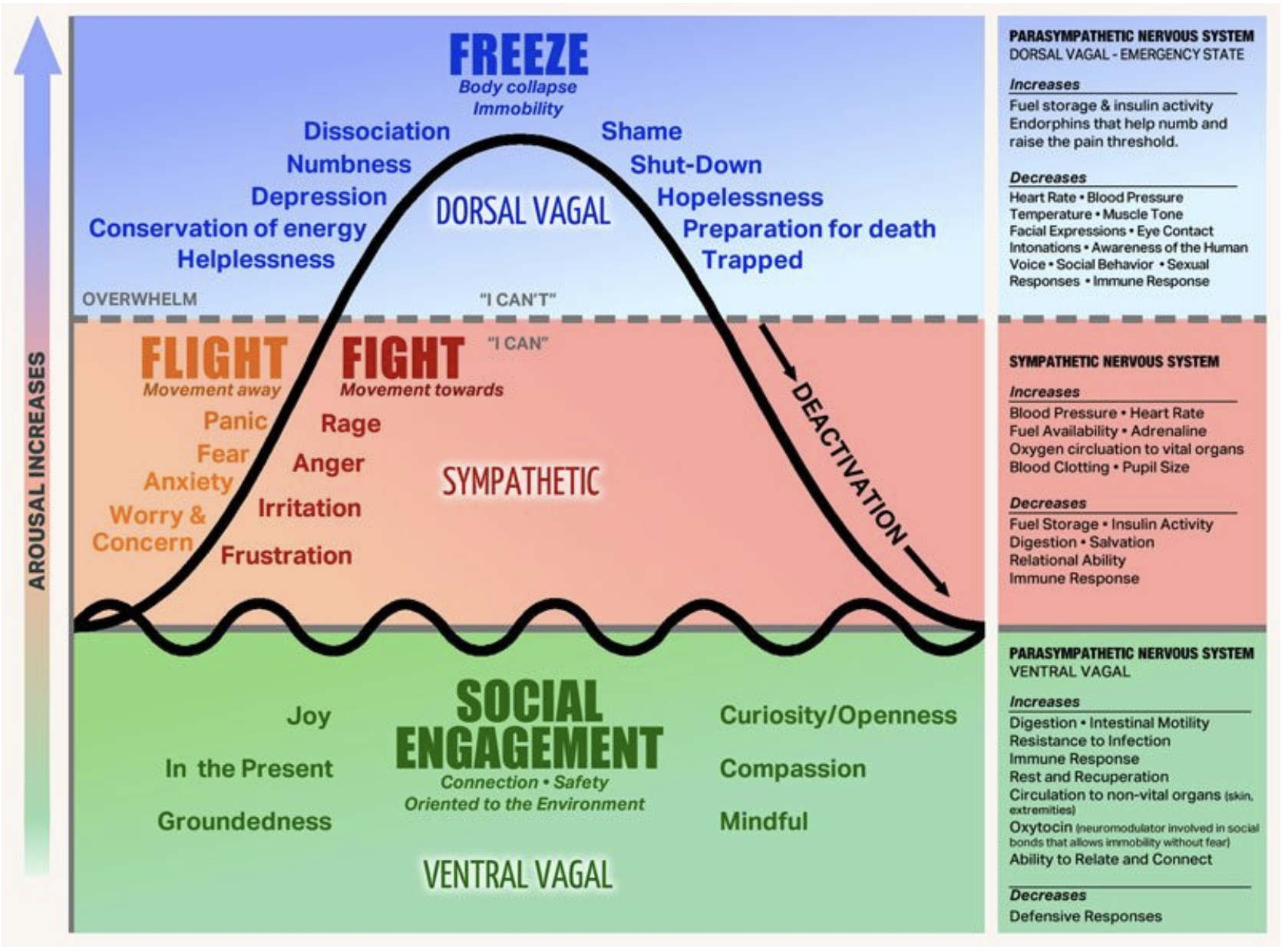
Polyvagal Theory Diagram Summary
Image Source: mind fully well
When chronic stress or trauma overloads your body, these pedals get jammed. Instead of shifting smoothly between them, your nervous system loses its flexibility and gets trapped in one of three survival loops:
Hyper-arousal (The Fight/Flight Loop): Driven by sympathetic nervous system activation, this feels like constant anxiety, racing thoughts, insomnia, panic attacks, an inability to relax, or feeling chronically overwhelmed. Your body is mobilized to fight a threat that isn't there.
Hypo-arousal (The Freeze Loop): Driven by the dorsal vagal pathway, this manifests as feeling emotionally numb, chronically exhausted, unmotivated, foggy-brained, or disconnected from your body (dissociation). Your body has slammed on the brakes to protect you from overwhelming stress.
The Hybrid Loop (The "Wired but Tired" Functional Freeze): Occurring when both systems activate simultaneously, this state causes you to feel intensely anxious and panicked on the inside, while appearing completely frozen, shut down, or physically exhausted on the outside.
Whether through self-guided somatic healing or clinical somatic therapy, the goal is the same: activating the ventral vagal state of the parasympathetic system to teach your nervous system that it is finally safe to step out of survival mode and return to a state of calm, regulated balance.
How to Downregulate an Overwhelmed Nervous System: 3 Simple Somatic Tools

You don’t need to wait for a therapy session to start connecting with your body
At first glance, the tools below might sound simplistic, maybe even annoyingly simplistic. You might find yourself thinking, “There is no way something this basic is actually going to work.” But these are deeply science-backed somatic practices. The trick isn't about looking for a magical overnight cure (though they absolutely can offer immediate, moment-to-moment relief). Instead, their true power comes from consistency. They are meant to work in tandem with intentional stress reduction, supportive daily living habits, and deeper therapy to gently train your nervous system back into sustainable balance.
1. The 5-Second Physiological Sigh
This is a rapid, biological trick to hack your brain's stress response. Take two quick inhales through your nose (one deep breath, followed immediately by a sharp second "top-off" inhale), then let out a long, slow exhale through your mouth with a sighing sound if possible. Doing this just three times instantly slows your heart rate and alerts your brain that the immediate danger has passed.
2. Somatic "Shaking" or Discharging
Watch a dog after a stressful encounter; they will naturally stand up and shake their entire body out. Animals do this instinctively to discharge residual stress hormones. If you feel a wave of anxiety, anger, or irritation, stand up and gently shake your hands, your arms, and your legs for 60 seconds. Let your muscles go safely and steadily completely loose. This practice physically releases accumulated adrenaline.
3. Orienting and Physical Micro-Grounding
When anxiety hits, it yanks us entirely up into our heads. To break that looping cycle, we have to drop our awareness back down into the body.
Sit quietly for a moment and pay attention to the literal weight of your body pressing against your chair. Now, notice your shoulders. Where are they holding? Gently drop them down and back, as if softly resetting your posture. Pay close attention to that exact physical transition: does it feel even a tiny bit more pleasant? If it does, pause and stay with that positive sensation for just a moment. By "staying," we simply mean notice it; let your brain register that small sigh of physical relief.
Finally, feel your feet firmly planted on the floor. Let your eyes drift around the room with zero pressure. Just orient yourself to where you are, noticing familiar, grounding items that signal to your brain that you are completely safe and supported in this exact moment in time.
Cultivating Daily Anchors for Healing

Regulating an overwhelmed nervous system doesn’t happen overnight; it is a lifelong practice built on tiny, daily rhythms of self-care and self-compassion.
Sometimes, the best way to quiet the "live wire" or drop out of your spinning thoughts is to build physical, tangible boundaries into your day that remind you to step away from the noise. Whether that means holding a cold, refreshing glass of water to ground your hands, wrapping yourself in a cozy, weighted blanket, or pulling on a favourite beanie as a literal, comforting symbol that you are going "offline" to rest, find the unique physical anchors that signal safety to your body.
Ultimately, somatic healing isn't about perfectly avoiding stress or pretending the chaos of life doesn't exist. It’s about building a body that knows exactly how to find its way back home to calm.
If your nervous system feels ready to explore these somatic rhythms with collaborative, real-time guidance, you can book a therapy session with me today so we can safely practice coming back into balance together.
You can reach out through my contact form under the Contact tab, or click "BOOK NOW" at the bottom of this page to schedule a free, low-stress 15-minute introductory call.
Let’s take that first gentle step back to your true self, together.
